
Purchase any Event and get
20% Off
CODE: TWENTY20
T&C applicable, please referFAQ
Validity : 11th Oct'26 to 21st Oct'26
When recurring interpersonal disruptions affect a workplace, attention naturally goes to the person whose behaviour appears to be causing the problem.
How do we get them to stop?
How do we coach them?
How do we change their behaviour?
Those can be legitimate questions. But they focus our attention on something we may have limited ability to control while leaving much of the organizational impact almost invisible.
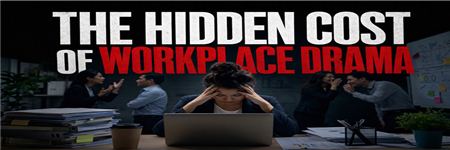
Hidden Costs of Drama examines the larger pattern that develops around the behaviour.
Participants explore what happens before an interpersonal disruption as people anticipate it, during the interaction itself, afterward as its effects spread and linger, and the negative effects of workarounds that gradually become part of how work gets done when the pattern continues.
The workshop examines those effects from three perspectives: the manager or leader, other staff, and the organization as a whole.
This isn't about excusing inappropriate behaviour or suggesting organizations shouldn't address it. It's about recognizing that changing another person's behaviour isn't the only place we have influence.
When we see the entire pattern, we begin to see choices and possibilities that were there all along.
If you lead or manage people, you've probably experienced situations where one seemingly minor interpersonal issue consumes far more time and attention than it should.
A dismissive response. An eye roll or prolonged stare. An unnecessary challenge to a routine request. A sarcastic comment. Being ignored or excluded. An emotional response that seems far bigger than the situation that triggered it.
None of these may seem particularly serious on their own. But when they become recurring interpersonal disruptions, something else starts happening.
People choose their words more carefully. They rewrite routine emails, wait for the right time to raise an issue, ask someone else to handle a conversation, or decide something isn't worth bringing up. After an interaction, they replay what happened, talk with coworkers, lose focus, or involve a manager who wasn't part of the original exchange.
Over time, some of these responses simply become the way work gets done. Certain conversations are avoided. Information takes different routes. Managers become buffers. Ideas go unspoken. People quietly learn how to work around particular situations.
And here's what makes the cost so easy to miss: many of these responses are perfectly reasonable.
But reasonable doesn't mean costless.
Hidden Costs of Drama will help you recognize the organizational impact that exists before, during and after these interpersonal disruptions, including the adaptations people make when they happen repeatedly. More importantly, you'll discover where you and your people have influence, even when the behaviour at the centre of the disruption doesn't change.

Since 1987 Michael has been consulting with businesses and organizations that understand the value of developing organizational culture and their people as a foundation for continual improvement, staff recruitment/retention, and enhancing organizational capacity. From large multi-national to entrepreneurial organizations, government and NGO’s, and across the spectrum of executive, senior managers, supervisors and staff.
HR (General) recertification credit hours toward aPHR™, PHR®, PHRca®, SPHR®, GPHR®, PHRi™ and SPHRi™ recertification through HR Certification Institute® (HRCI®). Please make note of the activity ID number on your recertification application form. For more information about certification or recertification, please visit the HR Certification Institute website at www.hrci.org

ComplianceIQ is recognized by SHRM to offer Professional Development Credits (PDCs) for the SHRM-CPSM or SHRM-SCPSM. This program is valid for [1] PDCs for the SHRM-CPSM or SHRM-SCPSM. For more information about certification or recertification, please visit www.shrmcertification.org.


